
Marrakech Mini Guide: ShortlistWhere I Stay, Eat, and Keep Coming Back
- Photos & words by
- Coco Tran
The short answer
Nineteen days in Morocco, Marrakech first, in March, when the light is long and gold and the medina does not bake you. This is the short version of what made the cut, the part you actually book from, led by four properties that do genuinely different things. Amanjena is the one I would send a honeymoon.
At a glance
- Setting
- A shortlist of Marrakech's can't-miss magic — the souks, the gardens, the rooftops and the riads
- Best for
- First-timers who want the Red City's highlights, beautifully distilled
- Standout
- The buzz of the medina, the serene Jardin Majorelle, and sunset from a rooftop over the whole city
- Consider
- The medina is a glorious maze — embrace getting lost, agree prices with a smile, and retreat to a riad to recharge
- Stayed
- Marrakech, March 2026 — Amanjena
Stayed at Amanjena, Marrakech, March 2026. Hotels here can be booked through Coco Tran Travel. How we review.
Nineteen days, best weather I've had in Morocco, Marrakech first before flying on to Turkey. This is the short version of what made the cut.
I went to Marrakech in March, which I'd argue is the window you want — the light is long and gold, the medina doesn't bake you alive, and the gardens are all coming into bloom before the summer crowds arrive. This isn't the full Rolodex; think of it as the short version I'd text a friend who's landing in three weeks and wants to know where to put her money. The full guide goes deeper on neighborhoods, day trips, and the people behind these places. This is the part you actually book from.
Where to stay
I keep coming back to four properties, and they do genuinely different things.
Amanjena
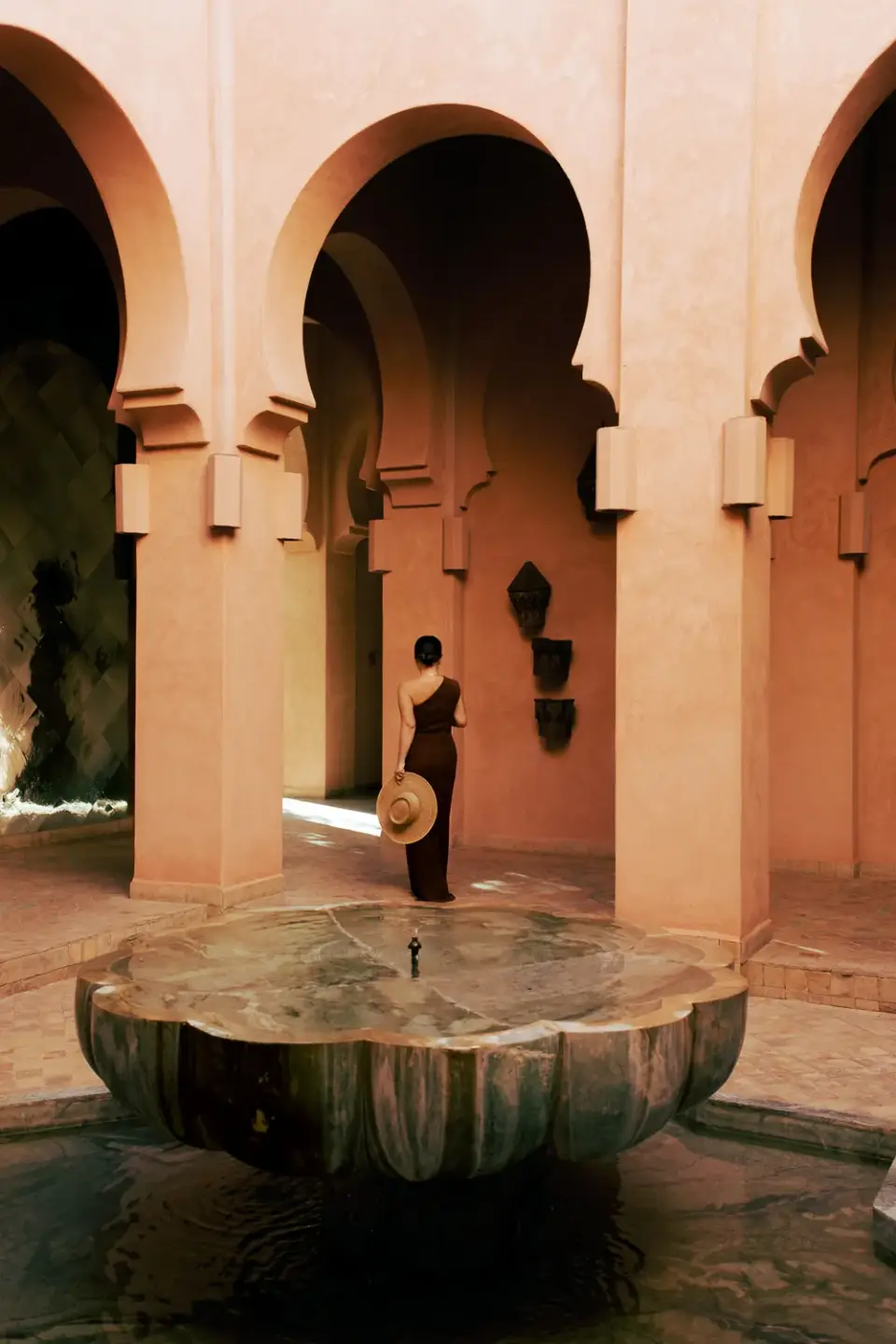
is the one I'd send a honeymoon or anyone who wants the city at arm's length. It sits out past the Palmeraie on the road to the Ourika Valley, built around a central reflecting pool called the bassin, and the whole place is modeled on the pavilions of the old Saadian gardens — pink pisé walls, domed pavilions, that deliberate Aman hush. Rates run well above $1,500 a night and you feel every dirham of it in the quiet. The restaurant, Nama, is worth staying in for; the chef there talks about the food the way a sommelier talks about wine.
Jnane Rumi
is the newer, smaller option I'd push toward anyone who finds the grand palaces a little performative. It's an intimate property with a garden built around water and citrus, and it feels personal in a way the big houses can't. Fewer rooms, more intention.
El Fenn
is where I'd put a design-minded friend. Vanessa Branson's riad in the medina is a warren of rooftops, plunge pools, and color — terracotta, saffron, deep blue — and it's steps from Jemaa el-Fnaa without feeling like you're sleeping in the chaos. It's the most fun of the four, and the rooftop bar at sunset is one of the best seats in the city.La Mamounia
It's the grand dame, and I don't say that dismissively. It's been operating since 1923, Jacques Garcia did the interiors, and the gardens — twelve hectares of them, with olive trees older than the hotel — are the real reason to book. You're a short walk from the Koutoubia and the medina, which Amanjena can't offer. It's a see-and-be-seen hotel; if you want a scene, this is your scene.Where to eat
Marrakech food runs from palace-formal to a plastic stool in the souk, and the trick is knowing which night is which.
Nama at Amanjena — if you're staying there, eat here at least once. Refined Moroccan with a lightness most of the heavy palace menus miss.
Bacha Coffee at Dar el Bacha is non-negotiable for me. It's inside a restored early-20th-century palace, the Dar el Bacha, and whether you go for the full lunch or just a pot of their coffee and a pastry in the courtyard, it's worth the stop for the room alone — the tilework, the fountain, the uniformed service.
Mö-Mö (Momo's) is where I'd book a proper dinner. It's the kind of place that gets the balance right between a scene and an actual good meal — go for the atmosphere and the cocktails as much as the plates.
Al Fassia in Guéliz deserves a mention for the real-deal Fassi cooking — it's famously run by women, and the tagines and the pastilla are the standard everything else gets measured against.
Otto's Rooftop —I had this on my list from a recommendation and loved the setting, but confirm the current details and hours before you build a night around it, because rooftop spots in the medina change hands and names more than you'd think.
Must visit
The medina is dense, so I'd pace this across a few mornings rather than trying to do it in a march.
Bahia Palace is the one to lead with — late-19th-century, built for a grand vizier, and the ceilings are the point: painted cedar, zellij, carved stucco in rooms that open onto courtyards. Go early before the tour groups.
Jardin Majorelle and the YSL Museum sit together and I'd do them as a pair, first thing in the morning. The garden is the cobalt-blue one Jacques Majorelle painted and Yves Saint Laurent later saved; the Berber Museum inside it (Musée Pierre Bergé des Arts Berbères) holds Saint Laurent's own collection of North African jewelry and textiles and is small enough to actually absorb. The YSL museum next door is a serious building in its own right.
Medersa Ben Youssef is the restored 16th-century Quranic school, and after its renovation it's one of the most quietly overwhelming interiors in the city — the central courtyard and the carved cedar are what you came to Morocco to see.
Maison de la Photographie is my favorite small museum in the medina — a riad full of early photographs of Morocco, with a rooftop café that gives you the medina skyline without the Jemaa el-Fnaa crush.
Le Jardin Secret on the Rue Mouassine is exactly what it sounds like — a restored riad garden you can duck into mid-medina when you need twenty minutes of shade and water.
Jemaa el-Fnaa and the souks you'll end up in whether you plan to or not; just go in the evening when the square comes alive with food stalls and musicians, and treat the souk as a wander, not a shopping list.
One of my favorite finds had no sign and no listing anywhere online — a tiny market just past Dabachi, behind Jemaa el Fna, selling olives, preserved lemons, harissa, and fresh verbena the way it's probably been sold there for a hundred years.
I also spent an hour at Cactus Thiemann, a cactus nursery, which sounds like an odd way to spend part of a Marrakech trip until you're actually standing inside it.
MACAAL — the Museum of African Contemporary Art Al Maaden, out near the Al Maaden golf district. Most itineraries never leave the medina, so a contemporary African art museum doesn't make the cut, and that's exactly why you should go. It's the counterpoint to all the heritage sites — proof that Marrakech is a living arts city, not a preserved one.
For the full picture — the High Atlas day trips, the Agafay desert, the artisans and the neighborhoods, plus the full 10-day route through the desert to Fes — see my complete Morocco guide Marrakech Rolodex.